Atradius Atrium
Get direct access to your policy information, credit limit application tools and insights.

 Ireland
 Australia
 Austria
 Belgium
 Brazil
 Bulgaria
 Canada
 China
China
 Czech Republic
 Denmark
 Finland
 France
 Germany
 Greece
 Group
Group
 Hong Kong SAR
 Hungary
 India
Ireland
India
Ireland
 Italy
Italy
 Japan
Japan
 Lithuania
 Mexico
 Netherlands
 New Zealand
 Norway
 Poland
 Portugal
 Romania
 Singapore
 Slovakia
 Slovenia
 Spain
Spain
 Sweden
 Switzerland
 Turkey
 United Arab Emirates
 United Kingdom
 United States

Latin America and the Caribbean (LAC) is once again demonstrating considerable resilience in a challenging global environment. Economic growth remains modest by emerging-market standards (figure 1), but major external shocks have not triggered the widespread instability experienced during earlier periods of global stress. Stronger monetary policy frameworks, flexible exchange rates and improved external buffers have made much of the region better able to absorb shocks.
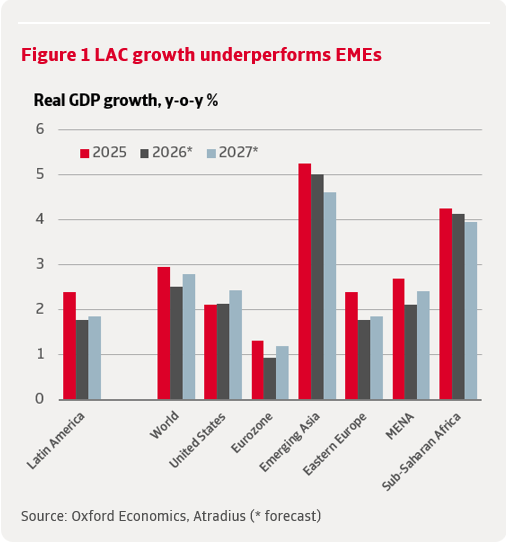
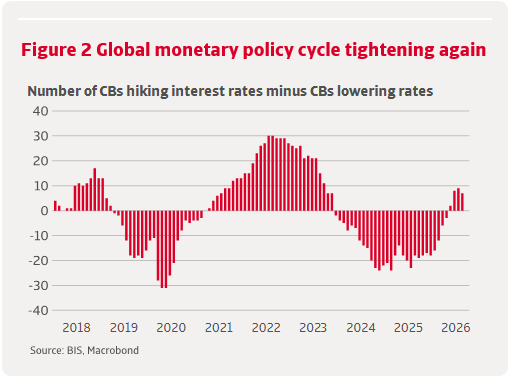
The external environment is becoming less supportive. The global economy is in a period of slower, increasingly uneven but still steady growth, with world GDP growth forecast to ease from 3.0% in 2025 to 2.5% in 2026 before recovering modestly to 2.8% in 2027. The US continues to outperform most advanced economies with AI-driven investment cushioning other sectoral slowdowns and fiscal expansion boosting growth further next year. Emerging Asia remains the main driver of global growth, although momentum is easing. However, energy-market disruption and higher freight costs resulting from the Iran war are keeping global inflationary pressures higher than expected. This is slowing disinflation, limiting the scope for monetary easing (figure 2) and keeping global financing conditions tighter for longer. Global trade is also losing momentum as geopolitical rivalries, supply-chain diversification and industrial policy measures reshape trade flows. For LAC, these trends matter mainly through commodity prices, export demand, investment flows and financing conditions.
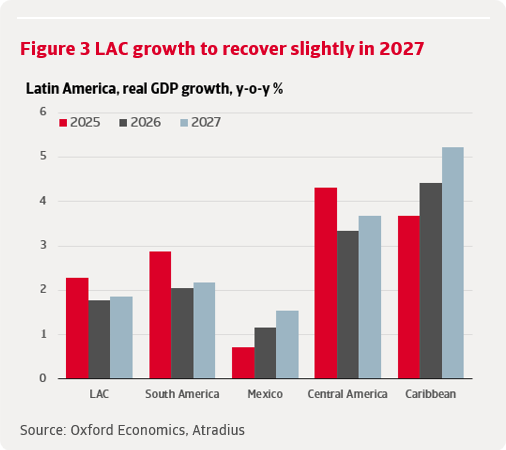
Growth prospects vary considerably across the region (figure 3). South America remains the weakest-performing subregion with growth expected to slow from 2.9% in 2025 to 2.0% in 2026 and 2.2% in 2027, dragged down by persistent inflation and tighter financing conditions. Mexico is also growing below its potential as concerns about the weakening rule of law, fiscal consolidation and uncertainty surrounding trade with the US keep growth close to only 1%. Central America has a more favourable outlook with strong remittance inflows supporting domestic demand. Growth in the Caribbean is set to outpace the other subregions, driven by tourism, investment and reconstruction efforts – as well as higher oil output from Guyana – although high debt and exposure to natural disasters remain important constraints.
The past year has been busy with many national elections that have brought significant changes in economic policy that could help reinforce the region’s resilience. New governments in Bolivia, Chile, Colombia, Costa Rica and Peru are placing greater emphasis on fiscal discipline, investment and structural reform, but implementation capacity and political support vary widely. Argentina continues to progress in correcting earlier macroeconomic imbalances, while reforms in countries including Paraguay and the Dominican Republic are strengthening institutional frameworks and investment prospects. These developments could improve resilience over time, but in the short term, fiscal consolidation may weigh on growth and intensify social pressures, particularly where adjustment follows an extended period of policy mismanagement in countries like Argentina and Bolivia.
The geopolitical environment has become more challenging amid the Iran war and US policy uncertainty, reflected in both a more interventionist regional stance and continuing trade-policy risks. The conflict in the Middle East, particularly the disruption of shipping through the Strait of Hormuz, has raised global prices for oil, gas, fertilisers and food since March. Although subsequent US-Iran negotiations eased some pressures, recent flare-ups have driven prices higher again, and the situation remains uncertain. As a net importer of oil, gas and fertilisers, the region faces higher import costs, renewed inflationary pressures and less room for monetary easing.
The effects of the conflict in the Middle East also vary across LAC. Energy-importing economies, particularly in the Caribbean and Central America, as well as Chile, are relatively vulnerable. Energy exporters such as Argentina, Brazil, Colombia and Guyana benefit from stronger export prices and higher production. However, even oil-producing economies face higher domestic costs because they often import refined fuels or fertilisers. Direct trade exposure to Gulf economies remains limited, reducing the region’s vulnerability compared with Asia and Africa.
At the same time, US influence in LAC is increasing as hemispheric security and economic interests move to the forefront of Washington's foreign policy agenda. The US has adopted a more interventionist stance, combining military intervention, economic coercion, sanctions and security cooperation to advance its objectives. This includes the January capture of Venezuela's President Nicolás Maduro by US forces and increasing pressure on Cuba, which the US frames as a national security concern. Although this pressure has so far focused on economic measures – expanded sanctions and an oil blockade – the risk of targeted military action remains elevated.
Initial threats of unilateral military action against drug-trafficking targets in Mexico and Colombia have gradually given way to a more collaborative approach centred on partnerships with national authorities and multilateral co-operation. The March launch of the Shield of the Americas initiative, aimed at creating an American Counter Cartel Coalition, reflects this shift. At the same time, the US has become more active in domestic politics, openly backing right-wing candidates in Honduras, Colombia and Brazil, while pressuring governments to reduce their reliance on Chinese investment, particularly in strategic infrastructure projects.
Climate risks compound these economic and geopolitical risks. According to the NOAA Climate Prediction Center, El Niño is strengthening, with a greater than 90% chance of a very strong event during the Northern Hemisphere autumn and winter of 2026-27. For October to December 2026, it estimates a 75% probability of an event exceeding the strength of previous El Niño episodes recorded since 1950. Moreover, the centre emphasises that stronger El Niño conditions increase the probability of typical impacts without guaranteeing them.
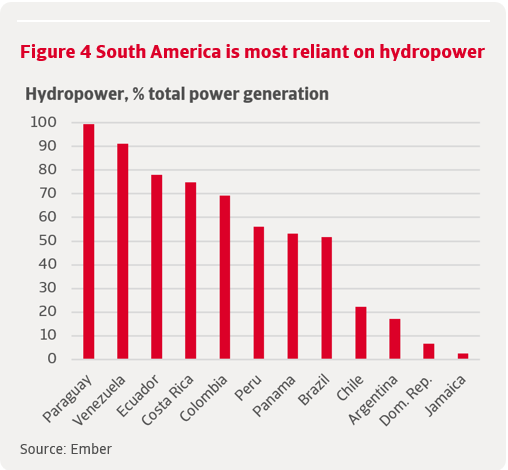
The economic effects of such a super El Niño will vary across LAC. Drought could weaken agricultural production and hydroelectric generation in parts of northern South America, Central America and the Caribbean. Elsewhere, excessive rainfall could damage crops, infrastructure and supply chains. Countries heavily reliant on hydropower, such as Paraguay, Venezuela and Ecuador, face an additional energy-security risk (figure 4), while food supply disruptions could sustain inflation and delay monetary easing.
The potential intensity of this event makes preparedness especially important. Strong public finances, disaster-risk financing and resilient infrastructure can help limit the economic damage. Ongoing reform efforts – from Argentina’s stabilisation programme to governance reforms in Paraguay and competitiveness reforms in the Dominican Republic – leave much of LAC better positioned to navigate shocks than in previous periods of global stress.
Download the full report in the related documents section below.